




Top things to do in Birmingham
Birmingham’s compact city centre is easy to explore on foot, with canal towpaths linking many of its main districts.
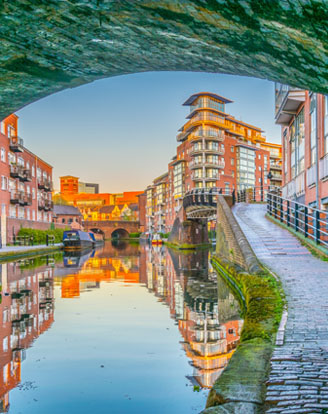
- Canals and Gas Street Basin — The city famously has more miles of canal than Venice. Stroll the towpaths from Gas Street Basin past narrowboats, bars and restaurants.
- Jewellery Quarter — A historic district still home to hundreds of jewellers and workshops, with a museum telling the story of the trade.
- Library of Birmingham — A striking modern library wrapped in metal filigree, with rooftop gardens offering views over the city.
- Birmingham Back to Backs — Restored nineteenth-century courtyard houses that show how working families lived during the industrial era.
- Barber Institute of Fine Arts — A small but outstanding art gallery on the university campus, with works by major European masters.
- Digbeth — The city’s creative quarter, known for street art, independent venues, food markets and live music.
- A balti curry — Birmingham is closely associated with the balti, a curry cooked and served in a thin steel bowl; try one in the city’s famous curry restaurants.
Best time to visit Birmingham
May to September is the most pleasant time to visit, with mild temperatures and long evenings for exploring the canals, parks and outdoor terraces. July and August are the warmest months, though showers are possible at any time of year.
Spring and autumn are cooler but good for museums, shopping and day trips into the surrounding countryside, with fewer visitors at the region’s major attractions.
Winter is cold and often damp, but from mid-November the city centre hosts a large German-style Christmas market, one of the biggest of its kind outside Germany and Austria, bringing festive lights and a lively atmosphere.
Getting from the airport
Birmingham Airport lies around 13 kilometres east of the city centre and has a direct rail connection via the nearby Birmingham International station.
- Train — A short automated shuttle links the terminal with Birmingham International station, where frequent trains reach Birmingham New Street in the city centre in around 10 to 15 minutes.
- Bus — Local buses connect the airport with the city centre in around 35 to 45 minutes, depending on traffic.
- Taxi — Taxis are available from the rank outside the terminal. The drive to the centre usually takes 20 to 30 minutes, longer at peak times.
Birmingham International station is also served by trains to other major cities, making it a convenient starting point for onward travel by rail.
Where to stay
Central Birmingham is walkable, and trains, buses and a tram line connect the wider city, so choose based on your plans.
- City centre — Close to New Street station and the main shopping streets, ideal for first-time visitors and short stays.
- Brindleyplace and the canals — A waterfront area with restaurants, bars and concert venues, suited to leisure travellers.
- Jewellery Quarter — A characterful historic district with independent restaurants and bars, a short walk from the centre.
- Digbeth — Creative and lively, popular with younger travellers and anyone attending gigs or events.
- Edgbaston — A leafy residential area near the university, cricket ground and botanical gardens, good for a quieter stay.
Travel tips
- Getting around — The centre is compact and walkable. Buses, local trains and the tram accept contactless payment, and New Street station is the main rail hub.
- Payment — Cards and contactless payments are accepted almost everywhere, including for small purchases.
- Tipping — Around 10 to 12.5 percent is customary in restaurants, but check the bill first, as a service charge may already be included.
- Weather — Rain can arrive at any time, so pack a light waterproof jacket and layers whatever the season.
- Day trips — Stratford-upon-Avon, Warwick and the Cotswolds are all within easy reach by train or car.
- Entry requirements — The United Kingdom is not part of the Schengen area and has its own entry rules, which depend on your nationality. Check official UK government sources before you travel.
Frequently asked questions
What is the best time to visit Birmingham?
May to September offers mild weather and long evenings for canal walks and outdoor dining. December is also popular for the city’s large German-style Christmas market, though it is cold and often damp.
Which airport serves Birmingham?
Birmingham is served by Birmingham Airport (BHX), located around 13 kilometres east of the city centre. It is linked to the nearby Birmingham International railway station by a short automated shuttle.
How do I get from the airport to the city centre?
Take the shuttle to Birmingham International station, where trains reach Birmingham New Street in around 10 to 15 minutes. Buses take around 35 to 45 minutes, and a taxi usually takes 20 to 30 minutes.
What currency is used in Birmingham?
Birmingham uses the pound sterling (GBP), like the rest of the United Kingdom. Cards and contactless payments are accepted almost everywhere, including on buses and for small purchases.
Do I need a visa to visit the United Kingdom?
Entry requirements for the UK depend on your nationality and the purpose of your trip. The UK is not part of the Schengen area, so check official UK government sources or the IATA Travel Centre before travelling.
What day trips can I take from Birmingham?
Stratford-upon-Avon, Shakespeare’s birthplace, is around an hour away by train. Warwick, with its medieval castle, and the villages of the Cotswolds are also popular and easy to reach by rail or road.
Updated: