




Top things to do in Budapest
Budapest’s main sights line both banks of the Danube and are easily reached on foot, by tram or on the metro, one of the oldest in continental Europe.
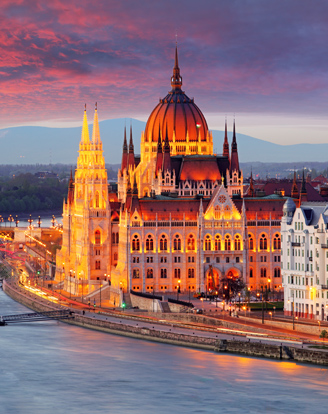
- Hungarian Parliament Building — A vast neo-Gothic landmark on the Pest riverbank, especially striking when lit up at night.
- Buda Castle — The former royal palace on Castle Hill, now home to museums and galleries, with sweeping views across the river.
- Fisherman’s Bastion and Matthias Church — Fairy-tale terraces and a colourful tiled church at the top of Castle Hill, perfect for photographs.
- Széchenyi Thermal Bath — One of Europe’s largest spa complexes, with warm outdoor pools set in a grand yellow building in City Park.
- Danube river cruise — A boat trip, particularly at dusk, reveals the city’s bridges, palaces and illuminated riverfront.
- St Stephen’s Basilica — The city’s largest church, whose dome offers panoramic views over Pest.
- Great Market Hall — A beautiful covered market selling paprika, salami, pastries and local specialities.
Best time to visit Budapest
Spring, from April to June, and autumn, in September and October, are ideal, with comfortable temperatures for walking, river cruises and outdoor cafés. These months are also less crowded than the height of summer.
July and August are hot and busy, with open-air bars, rooftop terraces and festivals, including a large music festival held on an island in the Danube each August. The outdoor thermal pools are pleasant all year round.
Winter is cold, with frost and occasional snow, but it is a great time to enjoy the steaming outdoor baths. From late November, Christmas markets around Vörösmarty Square and St Stephen’s Basilica bring mulled wine, crafts and festive lights.
Getting from the airport
Budapest Ferenc Liszt International Airport lies around 16 kilometres south-east of the city centre and is connected to Pest by bus and taxi.
- Airport express bus — A dedicated express bus runs from the terminal to Deák Ferenc Square in the city centre in around 35 to 40 minutes, depending on traffic.
- City bus and metro — Regular city buses link the airport with a metro station on line M3, from which you can continue to the centre. Allow around 45 to 60 minutes in total.
- Taxi — Use the official taxi stand outside the terminal. The drive to the centre usually takes 25 to 35 minutes.
Public transport tickets can be bought from machines at the airport; check which ticket is valid for the express bus before boarding.
Where to stay
Most visitors stay in Pest, which is flat and lively, while Buda offers a quieter, more historic setting.
- District V (Belváros-Lipótváros) — The heart of Pest near the Parliament, the basilica and the river, ideal for first-time visitors.
- District VII (Jewish Quarter) — Home to historic synagogues, street food and the famous ruin bars, suited to travellers who enjoy nightlife.
- Castle District — Charming and peaceful, with cobbled streets and views, good for couples and those seeking calm evenings.
- Andrássy Avenue area — An elegant boulevard lined with grand buildings, cafés and the Opera House, convenient for City Park and the metro.
Travel tips
- Getting around — Trams, the metro, buses and suburban trains share one ticketing system. Validate paper tickets before travelling, as inspections are common.
- Currency — Hungary uses the forint, not the euro. Cards are widely accepted, and choosing to pay in forint usually gives a better rate.
- Tipping — Around 10 to 15 percent is customary in restaurants, but check the bill first, as a service charge is sometimes already included.
- Thermal baths — Bring swimwear and flip-flops, and a towel if you prefer your own. Most baths are mixed and swimwear is required.
- Taxis — Use official taxi stands or book through an app rather than hailing unmarked cars.
- Entry requirements — Hungary is part of the Schengen area. Visa and entry rules depend on your nationality, so check official sources before you travel.
Frequently asked questions
What is the best time to visit Budapest?
April to June and September to October offer pleasant temperatures for sightseeing and river cruises. Summer is hot and lively, while December is lovely for Christmas markets and steaming outdoor thermal baths.
Which airport serves Budapest?
Budapest is served by Budapest Ferenc Liszt International Airport (BUD), located around 16 kilometres south-east of the city centre. It is Hungary’s main international airport, linked to the city by bus and taxi.
How do I get from the airport to the city centre?
An express bus runs to Deák Ferenc Square in the centre in around 35 to 40 minutes. City buses connect with metro line M3 in around 45 to 60 minutes in total, while a taxi takes about 25 to 35 minutes.
What currency is used in Budapest?
Budapest uses the Hungarian forint (HUF), not the euro. Cards are widely accepted, and choosing to pay in forint rather than your home currency usually gives a better exchange rate.
Do I need a visa to visit Hungary?
Visa requirements depend on your nationality and the purpose of your trip. Hungary is part of the Schengen area; check official government sources or the IATA Travel Centre for the latest entry requirements before travelling.
Which thermal baths can I visit in Budapest?
Budapest sits on natural hot springs and has many historic baths. Széchenyi in City Park is famous for its outdoor pools, while Rudas by the Danube has an Ottoman-era pool. Bring swimwear and flip-flops.
Updated: