





Top things to do in Kuala Lumpur
Kuala Lumpur combines striking modern landmarks with heritage districts, green spaces and some of Asia’s best street food.
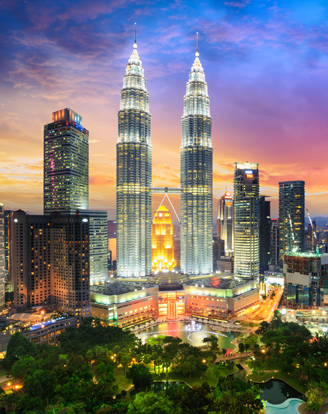
- Petronas Twin Towers — The city’s iconic twin skyscrapers, with a skybridge and observation deck, and the landscaped KLCC Park at their feet.
- Batu Caves — A sacred Hindu site in limestone caves on the city’s northern edge, reached by a colourful staircase guarded by a giant golden statue of Lord Murugan.
- Merdeka Square — The historic square where Malaysia’s independence was declared, framed by the Moorish-style Sultan Abdul Samad Building.
- Chinatown and Petaling Street — A bustling market street surrounded by temples, heritage shophouses and food stalls.
- Islamic Arts Museum Malaysia — One of the region’s finest museums of Islamic art, with beautiful architecture, textiles and manuscripts.
- Perdana Botanical Gardens — The city’s large green lung, with lakes, gardens and walking paths close to the National Mosque.
- Thean Hou Temple — A grand, multi-tiered Chinese temple on a hill, especially atmospheric when decorated with lanterns.
Best time to visit Kuala Lumpur
Kuala Lumpur has a hot, humid tropical climate all year, with daytime temperatures usually in the low 30s°C. The slightly drier periods, from December to February and from June to August, are generally considered the best times to visit, with more sunshine and fewer long storms.
The heaviest rain tends to fall during the inter-monsoon periods, around March to April and October to November, when afternoon and evening thunderstorms are frequent. Showers are usually intense but short, so a flexible plan and an umbrella are all you need. Humidity is high throughout the year, and indoor spaces are strongly air-conditioned.
Festivals are a highlight: Chinese New Year fills the city with lanterns, Thaipusam draws huge crowds of pilgrims to Batu Caves in January or February, and Hari Raya Aidilfitri marks the end of Ramadan with open houses and feasts. Deepavali, usually in October or November, is celebrated with lights and sweets.
Getting from the airport
Kuala Lumpur International Airport (KUL) is located in Sepang, around 50 km south of the city centre. It has two main terminals, KLIA Terminal 1 and KLIA Terminal 2, linked by train.
- Airport express train — A non-stop express train runs from both terminals to KL Sentral, the city’s main transport hub, in around 30 to 40 minutes. A slightly slower airport transit train makes a few intermediate stops.
- Taxi — Coupon and metered taxis are available from official counters and ranks in arrivals. The drive to the city centre takes around an hour, depending on traffic.
- Ride-hailing apps — App-based car services are widely used in Malaysia and operate from designated pick-up points at the airport.
- Airport coach — Coaches link the airport with KL Sentral and other locations; they are inexpensive but take around an hour or more.
From KL Sentral, the LRT, MRT, monorail and commuter trains connect to most parts of the city, making the train the most reliable way to avoid road traffic.
Where to stay
Kuala Lumpur is well served by rail lines, so staying near a station makes it easy to reach the main sights. Each district has its own character.
- KLCC — The area around the Petronas Twin Towers, with upscale hotels, shopping and the park; ideal for first-time visitors and business travellers.
- Bukit Bintang — The city’s shopping and entertainment hub, full of malls, street food and nightlife, popular with younger travellers.
- Chinatown — A heritage area near Merdeka Square with markets, temples and budget to mid-range hotels, great for culture and food.
- KL Sentral and Brickfields — Next to the city’s main rail hub and the vibrant Little India, very convenient for airport transfers and day trips.
- Bangsar — A relaxed residential district with cafés, restaurants and boutiques, suited to longer stays.
Covered walkways link several areas, including KLCC and Bukit Bintang, which is especially useful in the heat and during rain.
Travel tips
- Getting around — The LRT, MRT, monorail and commuter trains are affordable and easy to use. Ride-hailing apps are a convenient alternative to street taxis.
- Dress and etiquette — Dress modestly at religious sites; robes are often provided at mosques. Remove your shoes before entering temples, mosques and homes, and use your right hand when giving or receiving items.
- Food — Eating out is part of daily life. Hawker stalls and food courts are a great way to try Malay, Chinese and Indian dishes, and many restaurants are halal.
- Weather — Carry an umbrella and stay hydrated. Plan outdoor sights for the morning, before afternoon storms and peak heat.
- Payment and tipping — Cards and e-wallets are widely accepted, though cash is useful at markets and stalls. Tipping is not expected, as many restaurants add a service charge.
- Entry requirements — Visa and arrival rules depend on nationality and may include an electronic arrival card, so check before you travel.
Frequently asked questions
What is the best time to visit Kuala Lumpur?
Kuala Lumpur is warm all year. December to February and June to August are usually slightly drier, while March to April and October to November tend to bring the heaviest afternoon storms.
Which airport serves Kuala Lumpur?
Kuala Lumpur is served by Kuala Lumpur International Airport (KUL) in Sepang, around 50 km south of the city centre, with two main terminals, KLIA Terminal 1 and Terminal 2.
How do I get from the airport to the city centre?
The airport express train reaches KL Sentral in around 30 to 40 minutes and is the fastest option. Taxis and ride-hailing cars take about an hour depending on traffic, and airport coaches are cheaper but slower.
What currency is used in Kuala Lumpur?
Malaysia uses the Malaysian ringgit (MYR). Cards and e-wallets are widely accepted in malls, hotels and restaurants, but carry some cash for markets, hawker stalls and small shops.
Do I need a visa to visit Malaysia?
Visa requirements depend on your nationality and the purpose of your trip. Check official government sources or the IATA Travel Centre for the latest entry rules well before you travel.
How do I get to Batu Caves from Kuala Lumpur?
Batu Caves lies around 13 km north of the city centre. Commuter trains run from KL Sentral to Batu Caves station, a journey of around 30 to 45 minutes, or you can take a taxi or ride-hailing car.
Updated: