





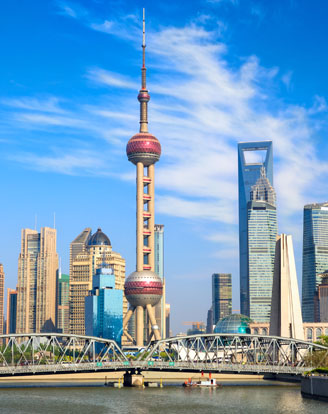
Top things to do in Shanghai
Shanghai combines historic neighbourhoods, riverside promenades and ultra-modern districts, and its metro makes it easy to move between them.
- The Bund — Walk the famous riverside promenade lined with grand early 20th-century buildings, with spectacular views of the Pudong skyline, especially when it lights up at night.
- Lujiazui, Pudong — Look up at landmark towers including the Oriental Pearl Tower and Shanghai Tower, and take in the city from one of the high observation decks.
- Yu Garden and the Old City — Explore a classical Chinese garden of rockeries, ponds and pavilions, surrounded by lively bazaar streets and traditional snack stalls.
- Former French Concession — Stroll plane-tree-lined avenues full of historic villas, boutiques and cafes, perfect for a relaxed afternoon.
- Shanghai Museum — Discover one of China’s finest collections of ancient bronzes, ceramics, calligraphy and painting.
- Tianzifang and Xintiandi — Wander restored shikumen lane houses now home to shops, galleries, restaurants and bars.
- Zhujiajiao water town — Take a short trip to this canal town with stone bridges and old houses, easily reached from the city.
Best time to visit Shanghai
The most pleasant times to visit are spring (March to May) and autumn (September to November), when temperatures are mild and conditions are ideal for walking the Bund, exploring gardens and taking day trips to nearby water towns. Autumn is often the most settled season, with clear skies and comfortable days.
June to early July brings the plum rain season, with frequent showers and high humidity, followed by a hot, sticky summer that lasts through August. Late summer and early autumn can occasionally bring typhoons. Winter (December to February) is cool to cold and damp, but crowds are thinner.
Chinese New Year (January or February) and the National Day Golden Week in early October are the busiest periods, when attractions and transport are very crowded. The city also hosts major trade fairs and events throughout the year, so booking accommodation early is wise.
Getting from the airport
Shanghai Pudong International Airport lies around 30 to 40 km east of the city centre, near the coast. Transfers are well signposted in Chinese and English. Shanghai is also served by Hongqiao Airport, west of the centre.
- Maglev train — The high-speed magnetic levitation train reaches Longyang Road station in about 8 minutes, where you can change to the metro to continue into the city.
- Metro Line 2 — Runs directly from the airport through Pudong to People’s Square and beyond. It is the most economical option but takes around 1 hour or more to the centre.
- Airport buses — Several routes link the airport with key districts and rail stations, taking roughly 60 to 90 minutes depending on traffic.
- Taxi — Use the official taxi ranks outside arrivals. The journey to Puxi or the Bund usually takes 45 to 75 minutes, longer at peak times.
Keep your hotel address in Chinese characters to show taxi drivers.
Where to stay
Shanghai is split by the Huangpu River into Puxi to the west and Pudong to the east. Staying close to a metro station is the key to getting around efficiently. Book early around public holidays and major trade fairs.
- The Bund and People’s Square — Central and iconic, ideal for first-time visitors who want to be close to the riverfront, museums and Nanjing Road.
- Former French Concession — Leafy and charming, with boutique stays, cafes and restaurants, suited to travellers who enjoy walking and a relaxed atmosphere.
- Jing’an — Stylish and well connected, with shopping streets, temples and business hotels, a good all-round choice.
- Lujiazui, Pudong — Modern high-rise district with river views, convenient for business travellers and quicker for trips to Pudong Airport.
- Hongqiao — Practical for travellers using Hongqiao Airport or the high-speed rail station next to it, with many business hotels.
Travel tips
- Getting around — The metro is extensive, affordable and signposted in English, and is usually faster than taxis at busy times. Ride-hailing apps are also widely used; save destination names in Chinese characters to show drivers.
- Payment — Mobile payment apps dominate everyday life, and many can be linked to foreign cards. Carry some cash and an international card as a backup.
- Tipping — Tipping is not expected in most restaurants or taxis, although some international hotels and restaurants add a service charge.
- Etiquette — Queue patiently for the metro, keep voices moderate in temples and museums, and remove your hat at religious sites.
- Safety and documents — Shanghai is generally safe for visitors, but watch for pickpockets in crowded areas. Carry your passport, which is needed for hotel check-in, trains and some attractions.
- Entry requirements — Rules vary by nationality and can change. Check before you travel.
Frequently asked questions
What is the best time to visit Shanghai?
Spring (March to May) and autumn (September to November) are the best times to visit Shanghai, with mild temperatures and pleasant walking weather. Summer is hot and humid, with a rainy season in June.
Which airport serves Shanghai?
Shanghai is served by Shanghai Pudong International Airport (PVG), about 30 to 40 km east of the city centre. The city also has Hongqiao Airport, located west of the centre.
How do I get from the airport to the city centre?
The Maglev train reaches Longyang Road in about 8 minutes, connecting with the metro. Metro Line 2 runs directly to People’s Square in about an hour, and taxis take roughly 45 to 75 minutes.
What currency is used in Shanghai?
China uses the renminbi, whose unit is the yuan (CNY). Mobile payments are the most common way to pay, but carrying some cash and an international card as a backup is recommended.
Do I need a visa to visit China?
Visa requirements depend on your nationality, the length of your stay and your travel plans. Check official government sources or the IATA Travel Centre for the latest rules before travelling.
What is the best way to see the Shanghai skyline?
Walk the Bund in the evening for classic views of the illuminated Pudong towers, take a Huangpu River cruise, or head up one of the observation decks in Lujiazui for a bird’s-eye view.
Updated:
