





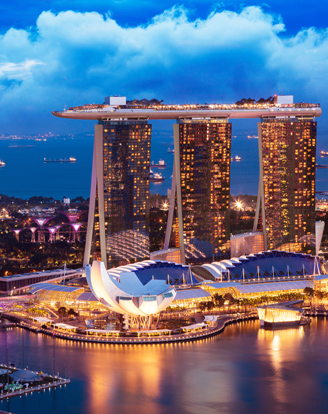
Top things to do in Singapore
Singapore packs world-class attractions, green spaces and multicultural neighbourhoods into a compact, well-connected island.
- Gardens by the Bay — Vast waterfront gardens with the iconic Supertree Grove and two giant cooled conservatories, spectacular when lit up at night.
- Marina Bay — The city’s glittering waterfront, with the Merlion statue, striking skyline views and an evening light show over the bay.
- Singapore Botanic Gardens — A UNESCO World Heritage Site, home to the National Orchid Garden and peaceful tropical walks.
- Hawker centres — Singapore’s hawker culture is recognised by UNESCO; try local favourites such as chicken rice, laksa and satay.
- Chinatown, Little India and Kampong Glam — Historic districts full of temples, mosques, shophouses, markets and food.
- Sentosa Island — A resort island with beaches, theme parks and attractions, linked to the mainland by road, cable car and monorail.
- Singapore Zoo and Night Safari — Renowned wildlife parks set in rainforest, with open, naturalistic enclosures.
Best time to visit Singapore
Singapore lies just north of the equator, so it is hot and humid all year, with temperatures typically between the mid-20s and low 30s°C. There is no true dry season, but February to April is often the most pleasant period, with slightly less rain and plenty of sunshine for outdoor sightseeing.
The northeast monsoon, from roughly December to early March, brings the wettest weeks, especially from November to January, with heavy showers that often pass quickly. The southwest monsoon, from around June to September, is generally drier but can bring early-morning storms and occasional haze. Rain rarely stops sightseeing for long, as the city has plenty of covered walkways and indoor attractions.
Singapore’s festivals reflect its many cultures: Chinese New Year lights up Chinatown in January or February, Deepavali transforms Little India in October or November, and Hari Raya Puasa marks the end of Ramadan in Kampong Glam. The year ends with festive light displays along Orchard Road and a New Year’s Eve celebration at Marina Bay.
Getting from the airport
Singapore Changi Airport (SIN) is located around 20 km east of the city centre and is one of the best-connected airports in the world.
- MRT (metro) — Trains run from the airport station between Terminals 2 and 3. Change at Tanah Merah to continue into the city; the journey to central stations such as City Hall takes around 30 to 45 minutes.
- Taxi — Metered taxis are available at clearly marked stands outside every terminal and reach the city centre in around 20 to 30 minutes. Surcharges may apply at certain times.
- Ride-hailing apps — App-based car services operate from designated pick-up points and are widely used by residents and visitors.
- Public buses and shuttles — Public buses connect the airport with many parts of the island, and shared shuttle services run to major hotels.
Singapore’s roads are efficient and well signposted, so both rail and road options are reliable at most times of day. You can pay for public transport by tapping a contactless bank card.
Where to stay
Singapore is compact and the MRT network is excellent, so almost any central area makes a convenient base. Choose according to your interests and budget.
- Marina Bay — Waterfront hotels, skyline views and quick access to Gardens by the Bay; ideal for business travellers and special occasions.
- Orchard Road — The famous shopping boulevard, with large hotels and malls, suited to shoppers and families.
- Chinatown and Tanjong Pagar — Heritage shophouses, restaurants and bars close to the business district, popular with food lovers.
- Bugis and Kampong Glam — A lively, central area with markets, cafés and boutique hotels near the Sultan Mosque, good for mid-range budgets.
- Sentosa — Resort-style hotels on the island, perfect for families and beach-focused stays.
Wherever you stay, check that it is within walking distance of an MRT station to make the most of Singapore’s public transport.
Travel tips
- Getting around — The MRT and buses are clean, safe and efficient. Tap a contactless bank card or mobile wallet to pay, or use a stored-value travel card.
- Local rules — Singapore is strict about public order: littering, jaywalking, smoking outside designated areas, and eating or drinking on the MRT can all lead to fines. Chewing gum is not sold.
- Staying cool — Wear light clothing, carry water and an umbrella, and plan outdoor visits for mornings and evenings. Indoor spaces are often strongly air-conditioned, so a light layer helps.
- Tipping and payment — Tipping is not expected, as restaurants usually add a service charge. Cards and mobile payments are accepted almost everywhere, though some hawker stalls prefer cash.
- Water and safety — Tap water is safe to drink, and the city has a very low crime rate, but normal precautions still apply.
- Entry requirements — Visa and arrival rules depend on nationality and may include completing an electronic arrival form, so check before you travel.
Frequently asked questions
What is the best time to visit Singapore?
Singapore is warm and humid all year, so any season works. February to April is often the most pleasant, with slightly less rain, while November to January tends to be the wettest period.
Which airport serves Singapore?
Singapore is served by Singapore Changi Airport (SIN), located around 20 km east of the city centre and widely regarded as one of the world’s best airports.
How do I get from the airport to the city centre?
The MRT runs from the airport to the city in around 30 to 45 minutes, with a change at Tanah Merah. Taxis and ride-hailing cars take around 20 to 30 minutes, and public buses are also available.
What currency is used in Singapore?
Singapore uses the Singapore dollar (SGD). Cards and mobile payments are accepted almost everywhere, including on public transport, but a little cash is handy for some hawker stalls and small shops.
Do I need a visa to visit Singapore?
Visa requirements depend on your nationality and the purpose of your trip. Check official government sources or the IATA Travel Centre for the latest entry rules well before you travel.
Is Singapore easy to get around by public transport?
Yes. Singapore’s MRT and bus networks are among the most efficient in the world, covering almost the whole island. Signs are in English, trains are frequent, and you can simply tap a contactless card to pay.
Updated: