




Top things to do in Toulouse
Toulouse’s historic centre is compact and best explored on foot, with brick churches, mansions and lively squares never far from the Garonne.
- Place du Capitole — The city’s grand main square, dominated by the long facade of the Capitole, home to the town hall and an opera house, with painted halls open to visitors.
- Basilica of Saint-Sernin — One of the largest Romanesque churches in Europe, with a distinctive octagonal bell tower and a place on the pilgrim route to Santiago de Compostela.
- Couvent des Jacobins — A Gothic convent church famous for its soaring palm-tree vault and peaceful cloister.
- Canal du Midi — A UNESCO-listed 17th-century canal lined with plane trees, ideal for walks, cycling and boat trips.
- Cité de l’Espace — A space-themed science park with full-size rockets, a planetarium and interactive exhibits, popular with families.
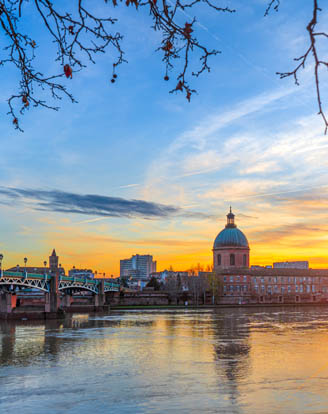
- Garonne quays and Prairie des Filtres — Riverside promenades and lawns where locals gather at sunset, with views of the Pont Neuf and the dome of La Grave.
- Aerospace heritage — An aviation museum near the airport displays historic aircraft, reflecting the city’s role in building airliners.
Best time to visit Toulouse
Toulouse enjoys a mild climate with plenty of sunshine. Spring, from April to June, is one of the best times to visit, with comfortable temperatures for walking the old town, picnics along the Canal du Midi and terrace dining on the squares. Violets, a local symbol, are celebrated in late winter.
Summer, from July to August, is hot and sunny, sometimes very hot, and the city can feel quieter as students and many residents leave on holiday. Evenings on the riverside quays are pleasant, and it is a good base for trips to the Pyrenees and the medieval city of Carcassonne.
September and October bring warm, settled weather, the return of student life and the start of the cultural season, making early autumn another excellent choice. Winter is cool and can be damp, with occasional frost but little snow in the city itself. It is a quiet, good-value time for museums, markets and the region’s famous slow-cooked dishes.
Getting from the airport
Toulouse–Blagnac Airport is located around 8 kilometres north-west of the city centre, close to the aerospace industry sites in Blagnac, and is easy to reach by public transport or road.
- Airport shuttle bus — A direct shuttle runs between the terminals, the city centre and the main railway station, Matabiau, taking around 20 to 30 minutes depending on traffic.
- Tram — A tram line links the airport with the city’s tram and metro network, with connections to the centre. Allow around 35 to 45 minutes including a change.
- Taxi — Taxis are available outside the arrivals hall. The drive to the centre usually takes 20 to 30 minutes, longer at peak times on the ring road.
Public transport tickets can be bought from machines at the stops or on board the shuttle. The metro, trams and city buses share one network, so a single ticket allows connections within a set time.
Where to stay
Toulouse is easy to get around with its two metro lines, trams and buses, but staying in or near the historic centre puts most sights within walking distance.
- Capitole — The heart of the city, ideal for first-time visitors who want to walk to the main square, Saint-Sernin and the best shopping streets.
- Carmes — A charming quarter of narrow lanes, delicatessens and a covered market, suited to food lovers and couples.
- Saint-Cyprien — Across the river on the left bank, with a village feel, local markets and lovely views of the quays.
- Saint-Étienne — An elegant, quieter area around the cathedral, with antique shops and handsome mansions.
- Near Matabiau station — Practical for train travel and the airport shuttle, with a wide range of accommodation at different budgets.
Travel tips
- Getting around — The metro, trams and buses share one ticketing system, and the centre is very walkable. Bike-share stations and cycle lanes make cycling along the canal and river easy.
- Local food — Try south-western specialities such as cassoulet, Toulouse sausage and duck dishes; the covered markets are great for lunch.
- Dining hours — Lunch is typically served from midday to around 2 pm and dinner from around 7.30 pm. Many restaurants close between services.
- Tipping — Service is included in French restaurant bills. Leaving a little extra for good service is appreciated but not required.
- Etiquette — Always greet staff with bonjour when entering a shop or café, and keep your voice low on public transport.
- Entry requirements — Visa and entry rules depend on your nationality. Check the latest requirements with official sources before you travel.
Frequently asked questions
What is the best time to visit Toulouse?
April to June and September to October offer warm, pleasant weather for exploring the old town and the Canal du Midi. Summer is hot and sunny, while winter is mild, quieter and good for museums and markets.
Which airport serves Toulouse?
Toulouse is served by Toulouse–Blagnac Airport (TLS), located around 8 kilometres north-west of the city centre. It is the main airport for the Occitanie region and is well linked to the city.
How do I get from the airport to the city centre?
A direct shuttle bus reaches the city centre and Matabiau station in around 20 to 30 minutes. A tram links the airport with the metro network in around 35 to 45 minutes, and a taxi takes 20 to 30 minutes.
What currency is used in Toulouse?
Toulouse uses the euro (EUR), like the rest of France. Cards and contactless payments are widely accepted, but carrying a little cash is useful for market stalls and small cafés.
Do I need a visa to visit France?
Visa requirements depend on your nationality and the purpose of your trip. Please check official government sources or the IATA Travel Centre for the latest entry requirements before travelling.
Why is Toulouse called the Pink City?
Toulouse earned the name La Ville Rose from the pinkish terracotta bricks used in many of its historic buildings, which glow in warm shades of pink and orange, especially at sunset.
Updated: