




Top things to do in Abidjan
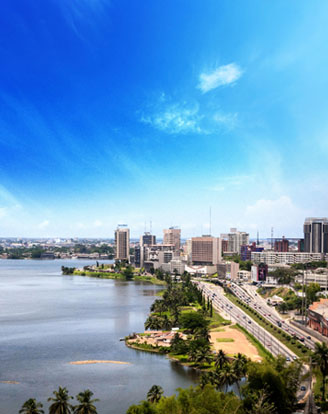
Abidjan's districts are spread across peninsulas and islands around the lagoon, each with a distinct feel.
- Le Plateau — The business district, whose towers earned Abidjan comparisons with Manhattan. Look out for the bold, modern St Paul's Cathedral overlooking the lagoon.
- Banco National Park — A protected tropical forest on the edge of the city, with walking trails beneath tall trees.
- Museum of Civilisations of Côte d'Ivoire — On the Plateau, a collection of masks, sculptures and objects reflecting the country's many cultures.
- Treichville Market — A busy market for fabrics, including colourful wax prints, crafts and everyday goods.
- Ébrié Lagoon — Take a boat trip or a water bus across the lagoon for a different view of the city.
- Grand-Bassam — The former colonial capital, east along the coast, whose historic quarter is a UNESCO World Heritage Site, with beaches nearby.
- Assinie — Further east, a strip of sand between lagoon and ocean, popular for weekend escapes.
Best time to visit Abidjan
Abidjan has a hot, humid tropical climate all year. The main dry season, from about December to March, is the best time to visit, with plenty of sunshine, although the Harmattan can occasionally bring hazy skies.
The main rainy season runs from around May to July, with June usually the wettest month. It is followed by a short, drier spell in August and September, and then a second, lighter rainy season around October and November.
Getting from the airport
Félix-Houphouët-Boigny International Airport (ABJ) is in Port-Bouët, on the coast south of the Plateau business district. Taxis, ride-hailing apps and hotel or pre-booked transfers are the easiest ways into the city. Traffic across the lagoon bridges can be heavy at rush hour, so allow extra time.
Where to stay
Most visitors choose between the business centre, the residential east and the lively south.
- Le Plateau — Ideal for business trips, close to offices, ministries and the museum.
- Cocody — A large, leafy district including Deux Plateaux and Riviera, with restaurants, shops and a calmer atmosphere.
- Marcory Zone 4 — A lively area with plenty of restaurants and nightlife, relatively close to the airport.
- Grand-Bassam — A relaxed coastal alternative for travellers who prefer the beach.
Travel tips
- Money: Carry cash in CFA francs for markets and taxis; cards are accepted in larger hotels and businesses, and mobile money is widely used.
- Getting around: Metered taxis and ride-hailing apps are convenient, and water buses cross the lagoon between some districts.
- Food: Try local favourites such as attiéké, a fermented cassava dish, and alloco, fried plantain, often served with grilled fish.
- Safety: Watch your belongings in busy areas, and do not swim where currents are strong; the Atlantic here can be dangerous.
- What to pack: Light, breathable clothing, sunscreen, insect repellent and an umbrella for sudden downpours.
- Before you go: Check the current entry and health requirements for Côte d'Ivoire before you travel.
Frequently asked questions
What is the best time to visit Abidjan?
December to March is the best time, during the main dry season, with sunny weather. The heaviest rains usually fall between May and July.
Which airport serves Abidjan?
Abidjan is served by Félix-Houphouët-Boigny International Airport (ABJ), located in Port-Bouët, south of the Plateau.
How do I get from the airport to the city centre?
Taxis, ride-hailing apps and pre-booked transfers are the most convenient options. Allow extra time at rush hour, when the lagoon bridges get busy.
What currency is used in Abidjan?
Côte d'Ivoire uses the West African CFA franc (XOF). Cash is useful for markets and taxis, while cards and mobile money are common in larger venues.
Do I need a visa to visit Côte d'Ivoire?
Entry requirements depend on your nationality and change from time to time. Check the latest requirements with RwandAir's travel requirements tool or the official government website before you travel.
Is Abidjan the capital of Côte d'Ivoire?
Yamoussoukro is the official political capital, but Abidjan is the country's largest city and economic capital, and many institutions are based there.
Updated: